This tutorial reports the software resurrection exercise
on the software code released as a part of the
following research paper in Computer Graphics.
Nehab et al. "Efficiently combining positions and normals for precise 3D
geometry." ACM Transactions on Graphics (2005) [doi].
Nehab et al. (2005) describe a method to combine information
from two different sources in order to recover a more detailed
geometry (i.e. 3D shape) of an object. A stereo triangulation
method can capture 3D geometry of an object and represent it
using triangular meshes. A photometric stereo method can
capture the surface normal at each point represented by a
pixel in an image. These two methods capture different types
of detail about the 3D geometry of an object. The stereo
triangulation method captures overall shape of an object but
is unable to accurately capture fine details (i.e. high
frequency details). The photometric stereo method can capture
fine details about the geometry but is unable to capture depth
information accurately. The insight of Nehab et al. (2005) was
to combine these two sources of information in order to
recover a more detailed and accurate 3D geometry of an object
that contains finer
details. The research
paper provides a more accurate and detailed description of
the method.
I read this paper during
my MSc and
wondered how do people come up with such wonderful ideas. What
amazed me was that Nehab et al. (2005) went a step further by
releasing the program code, documentation and sample data
required to reproduce the results reported in their research
paper. As a research student, these assets allowed me to
explore the proposed method in more detail and develop an
understanding of their method in a way that I can never
forget. This was in the year 2009-2010 at the University of
York (UK). In 2022, I was invited to give a talk at the
Vision, Graphics and Learning (VGL) group at the Department of
Computer Science in the University of York. To demonstrate the
concept of software resurrection, I chose the program code
released with Nehab et al. (2005) because the audience will be
able to connect with this software.
The software resurrection exercise for Nehab et al. (2005) is
described below. We use the following hardware and software
environment for software resurrection exercise of
sqlite-2002.
Hardware: A laptop purchased in 2019 with
the following specifications.
Model
Intel(R) Core(TM) i9-9980HK CPU @
2.40GHz
Architecture
x86_64
Byte Order
Little Endian
Address sizes
39 bits physical, 48 bits virtual
CPU(s)
16 (Family: 6, Model: 158, cpu MHz: 800.072)
Threads per code
2
Core per socket
8
Socket
1
Memory
Cache: 16 MB, RAM: 32 GB
Software
Operating System
Debian GNU/Linux 11.3 (bullseye) released on March 26th 2022
Compiler
gcc-10.2.1 (Debian 10.2.1-6) 20210110
2. Compile
The source
code is downloaded and extracted. A readme.txt file is
missing but the cc file extension suggests that
this is a C++ source code. The mesh_opt.cc source
file is compiled using the g++ compiler which
reveals the first compilation error.
## Prepare environment
export ROOT=$HOME/sr/nehab2005combining
mkdir -p $ROOT && cd $ROOT

## Download source
wget https://w3.impa.br/~diego/software/NehEtAl05/mesh_opt.tar.gz
tar -zxvf mesh_opt.tar.gz
g++ -o mesh_opt mesh_opt.cc
mesh_opt.cc:15:10: fatal error: cholmod.h: No such file or directory
   15 | #include "cholmod.h"
      |          ^~~~~~~~~~~
compilation terminated.
The Debian package manager informs that
the cholmod library is already installed. This
implies that the g++ compiler was unable to locate
the installed cholmod library. The location
of cholmod library is manually found and the
compiler is instructed to locate the missing library from this
custom location. As the cholmod library get
successfully located, another dependency library
(i.e. trimesh
library) goes missing.
sudo apt install libcholmod3
libcholmod3 is already the newest version

cd /usr/include
find . -iname 'cholmod.h'
./suitesparse/cholmod.h

g++ -o mesh_opt -I/usr/include/suitesparse/ mesh_opt.cc
mesh_opt.cc:16:10: fatal error: TriMesh.h: No such file or directory
   16 | #include "TriMesh.h"
      |          ^~~~~~~~~~~
compilation terminated.
The missing trimesh library is downloaded and as its
successful compilation required installation of another library
OpenGL Utility Toolkit (freeglut). The freeglut library was
installed using the Debian package manager.
wget https://gfx.cs.princeton.edu/proj/trimesh2/src/trimesh2-2.16.zip
unzip trimesh2-2.16.zip
cd trimesh2/
make../include/GL/freeglut_std.h:131:13: fatal error: GL/glu.h: No such file or directory
131 | # include
| ^~~~~~~~~~
compilation terminated.
sudo apt install freeglut3-dev
make...
Compiling mesh_view.cc
Linking ../bin.Linux64/mesh_view
The mesh_opt.cc source is recompiled after
installing all the required dependencies. The compilation
process breaks with the following error.
g++ -o mesh_opt \
-I/usr/include/suitesparse/ -I./trimesh2/include \
mesh_opt.ccmesh_opt.cc:93:23: error: ‘TriMesh’ was not declared in this scope; did you mean ‘trimesh::TriMesh’?
93 | static int isneighbor(TriMesh *mesh, int i, int j) {
| ^~~~~~~
| trimesh::TriMesh
Issue 2.1: The trimesh library interface has changed address.
The CHANGELOG
of trimesh2 library notifies of this breaking change as
follows.
Changes version 2.11 → 2.12:

Major user-visible change: the library and headers are now contained
within the trimesh namespace. Existing code must be updated to refer
to the TriMesh class and associated functions with an explicit
namespace qualifier, or include the following declaration

using namespace trimesh;
This breaking change in the trimesh library can be
addressed by appending the following statement to
the mesh_opt.cc source code which instructs the
compiler to automatically use the trimesh name
for all references to the Trimesh data
structure.
using namespace trimesh;
Fixing Issue 2.1 reveals other two issues with
the mesh_opt.cc source. These issues are easier
to fix as they relate to compilers enforcing certain rules
more strictly as compared to tolerance offered by compilers 17
years ago.
g++ -o mesh_opt \
  -I/usr/include/suitesparse/ -I./trimesh2/include \
  mesh_opt.cc
mesh_opt.cc: In function ‘void optimize_grid(trimesh::TriMesh*, float, float, const t_fc&)’:
mesh_opt.cc:178:23: error: invalid conversion from ‘void (*)(int, char*, int, char*)’ to ‘void (*)(int, const char*, int, const char*)’ [-fpermissive]
  178 |     c.error_handler = handler;
      |                       ^~~~~~~
      |                       |
      |                       void (*)(int, char*, int, char*)
mesh_opt.cc: In function ‘void optimize_mesh(trimesh::TriMesh*, float, float)’:
mesh_opt.cc:348:23: error: invalid conversion from ‘void (*)(int, char*, int, char*)’ to ‘void (*)(int, const char*, int, const char*)’ [-fpermissive]
  348 |     c.error_handler = handler;
      |                       ^~~~~~~
      |                       |
      |                       void (*)(int, char*, int, char*)
mesh_opt.cc:366:15: error: ‘vector’ does not name a type
  366 |         const vector<int> &af = mesh->adjacentfaces[v];
      |               ^~~~~~
mesh_opt.cc:367:18: error: ‘af’ was not declared in this scope; did you mean ‘nf’?
  367 |         int nf = af.size();
      |                  ^~
      |                  nf
Issue 2.2: Compilers are more strict now than they
were 17 years ago.
The first issue of invalid conversion ... is
resolved by adding the qualifier const to the
function arguments as required by the CHOLMOD library's error
handler. The second issue related to vector is
fixed by adding std:: namespace to the
declaration of variable af of the STL
type vector.
File: mesh_opt.cc
...
// CHOLMOD error handler
//static void handler(int status, char *file, int line, char *message) {
static void handler(int status, const char *file, int line, const char *message) {
...
    // Normal constraints
    int row = nvars;
    for (int v = 0; v < nvars; v++) {
//        const vector &af = mesh->adjacentfaces[v];
        const std::vector &af = mesh->adjacentfaces[v];
...
The compilation process completes successfully but the
linking stage breaks with a large number of undefined
reference to ... errors. These errors are fixed by
manually pointing the compiling to static library that contains
the definition of those symbols. These library names were
manually found by hit-and-trial method. The following command
leads to successful compilation and linking of
the mesh_opt.cc source file resulting in the
required mesh_opt executable.
g++ -o mesh_opt \
  -I/usr/include/suitesparse/ \
  -I./trimesh2/include \
  -fopenmp mesh_opt.cc \
  ./trimesh2/lib.Linux64/libtrimesh.a \
  /usr/lib/x86_64-linux-gnu/libcholmod.a \
  /usr/lib/x86_64-linux-gnu/libblas.a \
  /usr/lib/x86_64-linux-gnu/libsuitesparseconfig.a \
  /usr/lib/x86_64-linux-gnu/libcolamd.a \
  /usr/lib/x86_64-linux-gnu/libmetis.so.5 \
  /usr/lib/x86_64-linux-gnu/libccolamd.a \
  /usr/lib/x86_64-linux-gnu/libcamd.a \
  /usr/lib/x86_64-linux-gnu/libamd.a

./mesh_opt

Usage: ./mesh_opt infile [options] [outfile]
Options:
   -fc file.fc     Range grid camera intrinsics (i.e. fx fy cx cy)
   -lambda         Geometry weight
   -blambda        Boundary geometry weight
   -fixnorm s[:n]  Fix normals by smoothing n times with sigma=s*edgelength
   -smooth s[:n]   Smooth positions n times with sigma=s*edgelength
   -opt            Run one optimization round
   -noopt          Do not optimize
   -noconf         Remove per-vertex confidence
   -nogrid         Unpack range grid to faces
3. Test
Nehab et al. (2005) have not included a self-contained
and automated test to verify the functionality of
the mesh_opt executable program. This would have
allowed us to verify that the program is operating as was
expected by the developers during its release in the year
2005.
The authors have included detailed documentation about
the mesh_opt program as well as provided data
samples
and examples
(along with the expected output) to guide users in reproducing
the results presented in the research paper. To reproduce the visualisation included in the paper, the
samples
are downloaded and the mesh_opt program is executed
using exactly the same command line arguments provided in
the examples.
wget https://w3.impa.br/~diego/software/NehEtAl05/samples.tar.gz
tar -zxvf samples.tar.gz
./mesh_opt panel/panel-small.ply -fc panel/panel-small.fc -fixnorm 2:3 optimized.ply
Reading panel/panel-small.ply...
  Reading 116408 vertices...
  Reading range grid... Done.
Fixing normals (2:3)...
Triangulating... 230778 faces.
Removing faces... 479 faces removed... Done.
  Computing point areas... Done.
Finding vertex neighbors... Done.
Smoothing normals... Done.  Filtering took 0.062695 sec.
Smoothing normals... Done.  Filtering took 0.055074 sec.
Smoothing normals... Done.  Filtering took 0.051286 sec.
Computing normals... Done.
Smoothing normals... Done.  Filtering took 0.053773 sec.
Smoothing normals... Done.  Filtering took 0.054504 sec.
Smoothing normals... Done.  Filtering took 0.052540 sec.
Done.
Range grid optimization...
  Analyzing range grid... Done.
  Building system (116408x349115)... Done.
  Analyzing matrix... Done.
  Factoring matrix... Done.
  Back substituting... Done.
  Updating range grid... Done.
Writing optimized.ply... Done.
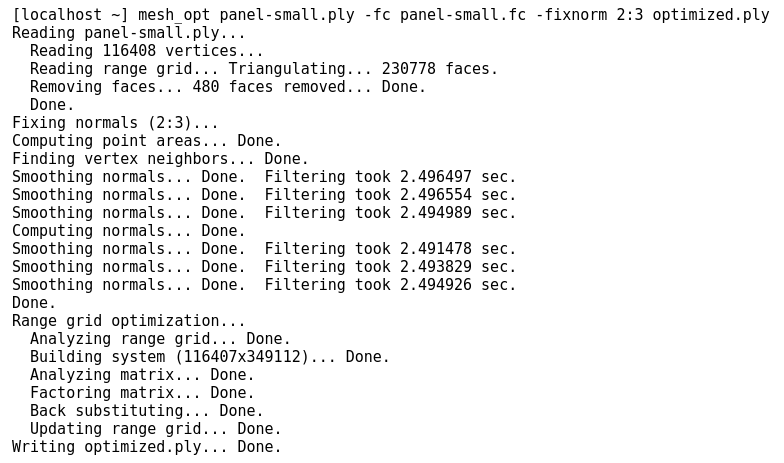
Expected
output from running the mesh_opt on the
provided sample data.
Apart from the execution time differences, the following
differences exists between the obtained output and expected
output of the mesh_opt command. The author's output
shows "Removing faces... 480 faces removed" while our output
shows "Removing faces... 479 faces removed". This suggests that
the mesh_opt program is behaving in slightly
different ways than what was observed by the authors in
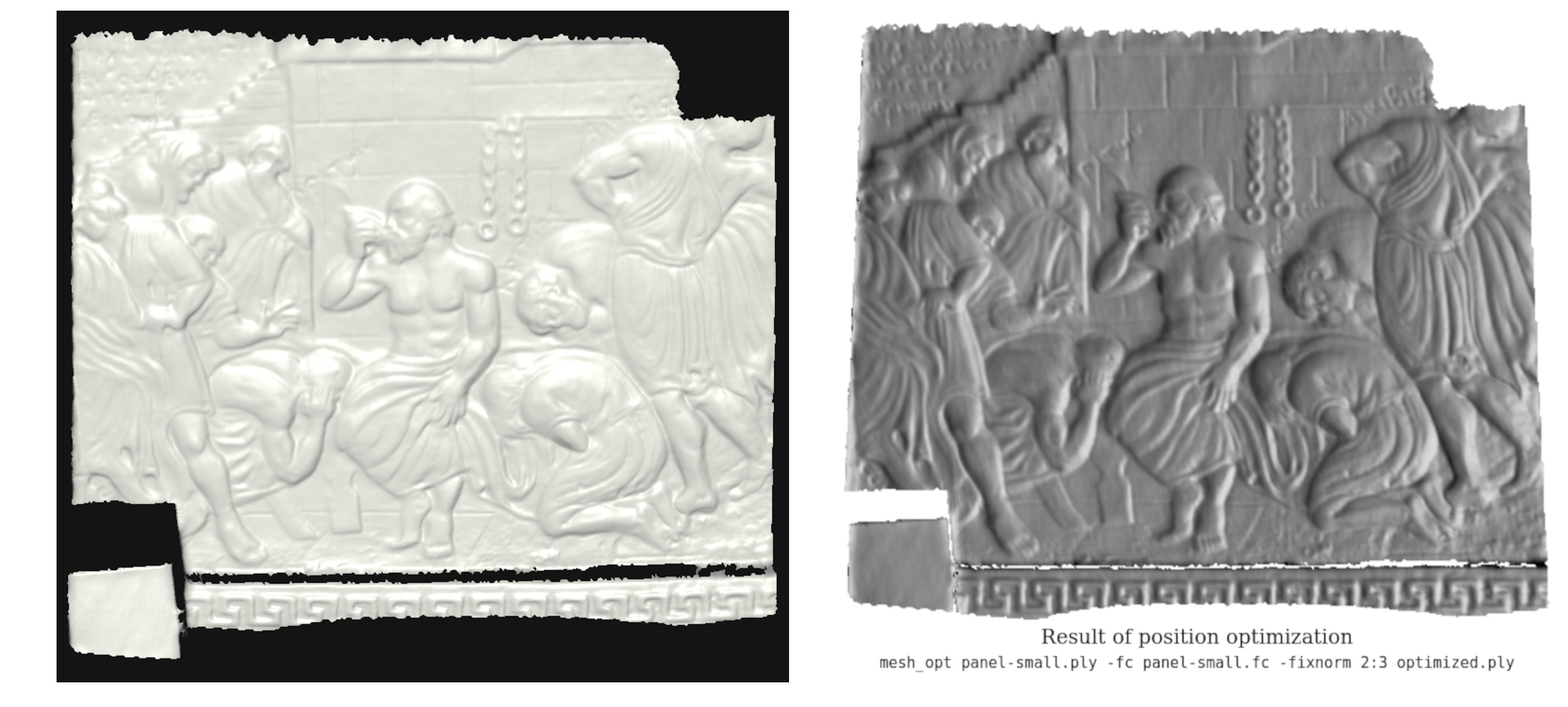
2005. The generated output mesh looks visually similar as shown
below. However, it is not possible to confirm this as the
processed results (i.e. optimized.ply) are not
included in the provided dataset.
Visualisation of our optimised mesh (left) and the
visualisation included in
the examples. The
brightness difference is caused by light source used for
visualisation and is not important here.
4. Critique
The compilation and testing (i.e. manual comparison of
output) of code released by Nehab et al. (2005) provided some
valuable insights into the factors that contribute to the
intelligibility and maintainability of a research software.
4.1 To Depend or Not to Depend is a profound question that the
wise can answer.
The C++ code of Nehab et al. (2005) depends on the following
two libraries:
(a) trimesh2
and
(b) CHOLMOD.
The trimesh2 library is still being maintained (last release
was in 2020) and therefore its compilation is straightforward after
its dependency (i.e. freeglut library) was installed using the
operating system's package manager. The trimesh2 library
introduced a breaking change in 2013 (i.e. in release version
2-2.12) which moved all the library assets to
the trimesh namespace in order to avoid naming
conflicts with other libraries or user code. This breaking
change required a minor update to the source code of Nehab et
al. (2005).
The original CHOLMOD library has now been integrated with
other linear algebra libraries in
the SuiteSparse
and therefore resolving this dependency required some
significant effort.
I first tried to compile this code in 2009 during my MSc and
I don't recall facing any major issues during the
compilation. My colleague, who was doing his PhD during that
time, also had compiled this code successfully in his machine
and used it for his doctoral research. So, I know that this
research code compiled without much friction in 2009. However,
when I re-compiled this research code in 2022, I faced many
issues. Most of these issues were related to the changes in
dependency libraries. These issues have also been faced by
others. The waps101/MergePositionNormals
project created a MATLAB implementation of the research code
from Nehab et al. because the original C-language based
implementation had become "more difficult to compile over the
years due to required dependencies".
I do not know if there was a way, in 2005, to ship a research
code like Nehab et al. (2005) that could have prevented dependency
issues after 17 years. I will revisit this question in future
when I gain a better understanding of the state of software
packaging and distribution in the year 2005.
4.2 Don't rely on compilers to always be nice to you.
Compiler tolerate certain programming practices for various
reasons. For example, the following statement exists in the
source code of Nehab et al. (2005).
The existence of the statement const
vector<int> ... indicates that the authors must have
missed to include the std:: namespace prefix
because other similar declarations does include the required
prefix std::vector. This code must have compiled
successfully in 2005; possibly with a compiler warning
message. In the year 2022, compilers generate an error, instead
of a warning, thereby requiring an update to the source
code.
Compiler warnings will turn into error. Therefore, it is
wise to heed to those warnings and update the code to address
the issue in order to avoid breaking the code in the future.
4.3 Tests build trust.
While we were able to run the executable in a modern
machine, it was not possible to verify if the software was
operating in the way expected by the authors in 2005. We also
noticed a minor difference in the observed output and expected
output (as documented in the reference manual).
## 2022 (output obtained using modern hardware and software libraries)
...
Removing faces... 479 faces removed... Done.
...

## 2005
...
Removing faces... 480 faces removed... Done.
...
This discrepancy in the output makes one wonder if there is
something amiss in the software code or the dependency
library. This situation could have been avoided, to some extent,
by including a set of self-contained and automated tests which
would have helped the user to narrow down the issue. This
discrepany has revealed the contribution of a software test
suite in building trust with its users.
4.4 Code will run faster in future machines.
Reproducing the results reported by Nehab et al. (2005)
revealed that the code ran 45 times faster in a modern hardware
and software platform.
## 2022 (output obtained using a modern hardware and software libraries)
...
Smoothing normals... Done.  Filtering took 0.062695 sec.
...

## 2005
...
Smoothing normals... Done.  Filtering took 2.496497 sec.
...
This observation suggests that code execution will be faster
in future platforms just because of improvements in hardware and
software libraries. It also encourages developers to resist the
temptation to optimise their code in order to save a few CPU
cycles during execution. Such optimised code are often difficult
to understand, maintain and fix. Therefore, it is wiser to write
code that are easier to understand and runs at acceptable speed
as compared to highly optimised code that runs faster but is
difficult to understand and maintain.
4.5 Code and Documentation Should be Co-located.
The downloaded archive file contains a C++ source code, an
executable file and some sample data. I missed a readme.txt file
in the archive which usually provides details about compiling
the source code, running the executable, expected output,
description of the provided sample data, etc. After some
exploration,
the reference
manual page and examples page were
discovered online. These pages are well written and proved
extremely useful in understanding the process of reproducing
the results reported in the paper. It would have been easier to
locate if these HTML documents were included inside
a doc folder of the downloaded archive file. In
retrospect, the main website of Nehab et al. (2005) clearly
shows a documentation section containing links to the
reference manual and examples. For some reason, I downloaded
the source and started to look inside the archive for the
required documentation.
4.6 Code and documentation of Nehab et al. (2005) is
intelligible and maintainable.
The code and documentation of Nehab et al. (2005) was easy
to understand, interesting to read and easy to fix. It was
remarkable to see a code written 17 years ago becoming alive and
running 45 times faster in a modern hardware and software
platform. The reference manual and examples page are clear and
easy to understand. The source code is well documentation and
intelligible.