1. Introduction
This article describes compilation and testing of a historical software release of the SQLite database engine on a modern hardware and software platform. The goal is to learn the software engineering principles that emerge from the issues encountered during resurrection of a well maintained and widely adopted open source software. This learning exercise, called software resurrection, has been introduced in the following paper (pdf).
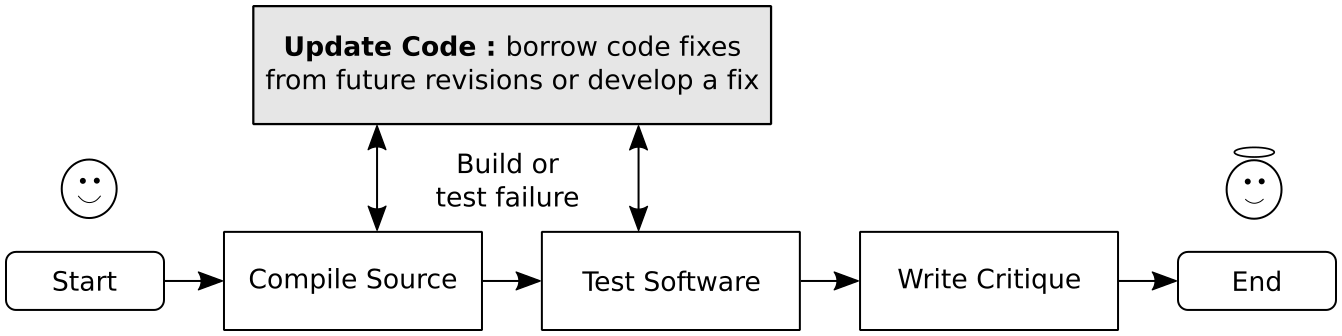
The SQLite database engine has been selected for software resurrection because of the following reasons.
- Long History
- The SQLite software has a long history (of more than 20 years) of being actively developed and maintained. Software issues related to maintainability of a software show up only when we look at longer time scales (e.g. a span of 20 years). A software released only few years ago (e.g. 3 years ago) is most likely to compile successfully in a modern platform because the hardware and software dependencies do not introduce breaking changes in such a short span of time. Therefore, old releases of SQLite are suitable for the software resurrection exercise.
- Version Controlled History
- The SQLite software project maintains a publicly accessible Version Control System (VCS) history of all code revisions since 29th May 2000. For example, the VCS checkout (or commit) and source code distribution for sqlite-2.2.1 are publicly accessible in a online format and are available to download for offline use as well. Since SQLite has been actively developed and maintained, its version controlled history is highly likely to contain a fix for the issues encountered during software resurrection of sqlite-2002. If the learner is unable to develop a fix for an issue, the learner will explore different source of information (e.g. web search, documentation, etc.) to obtain a fix. The version control history is also a possible source of ideas for a fix or may even contain the fix in a form that is easy to borrow.
- Self Contained Tests
- The self contained test suite included with the old releases of SQLite allows us to verify the functionality of the sqlite software in a modern platform. Such tests are essential to assure the learner that the fixes applied to compile the software in a modern platform has not changed the behaviour of the software.
- Familiarity with the Programming Language
- SQLite is developed using the C programming language. The author of this article is familiar with the C programming language and therefore this software can be resurrected by the author of this article.
We pursue software resurrection exercise on the sqlite-2.2.1 (VCS checkout, source distribution) version which was released on 9th January 2002 (more than 20 years ago). We use the keywords sqlite-2002 throughout this article to refer to sqlite-2.2.1. This software release version is no longer maintained and is not recommended for use in production system. However, this article will show that sqlite-2002 is a valuable resource for learning and that it may contribute growth in wisdom of the learner. We use the following hardware and software environment for software resurrection exercise of sqlite-2002.
-
Hardware: A laptop purchased in 2019 with
the following specifications.
Model Intel(R) Core(TM) i9-9980HK CPU @ 2.40GHz Architecture x86_64 Byte Order Little Endian Address sizes 39 bits physical, 48 bits virtual CPU(s) 16 (Family: 6, Model: 158, cpu MHz: 800.072) Threads per code 2 Core per socket 8 Socket 1 Memory Cache: 16 MB, RAM: 32 GB -
Software
Operating System Debian GNU/Linux 11.3 (bullseye) released on March 26th 2022 Compiler gcc-10.2.1 (Debian 10.2.1-6) 20210110
In the next section, we begin the software resurrection process by compiling the sqlite-2002 database engine on a modern hardware and software platform. All the steps described in this tutorial can be reproduced by executing a single script as follows.
Patch sqlite-2.2.1 released in 2002 such that it compiles in a modern hardware and software platform.
mkdir -p $HOME/sr/sqlite/2.2.1/
cd $HOME/sr/sqlite/2.2.1/
wget https://abhishekdutta.org/sr/exercise/sqlite/2.2.1/patches.zip
unzip patches.zip
cd patches

## the apply-patch.sh script does the following
## 1. downloads sqlite-2.2.1 source
## 2. applies patches
## 3. builds sqlite and executes regression tests
./apply-patch.sh $HOME/sr/sqlite/2.2.1/sqlite/